
Stellenbosch is a major heartland for South African honey production and apiary science. Thanks to the legendary biodiversity of the surrounding Cape Floral Kingdom—specifically the unique, nectar-rich fynbos—alongside vast fruit orchards and eucalyptus belts, the Cape Winelands create ideal, year-round conditions for the indigenous Cape honeybee (Apis mellifera capensis). Managed hives across Stellenbosch are critical not just for producing distinctive, single-origin honeys, but also for pollinating the region’s massive agricultural output.
Long before modern apiarists were managing hives in the Winelands, however, humanity held a very different view of hive dynamics.
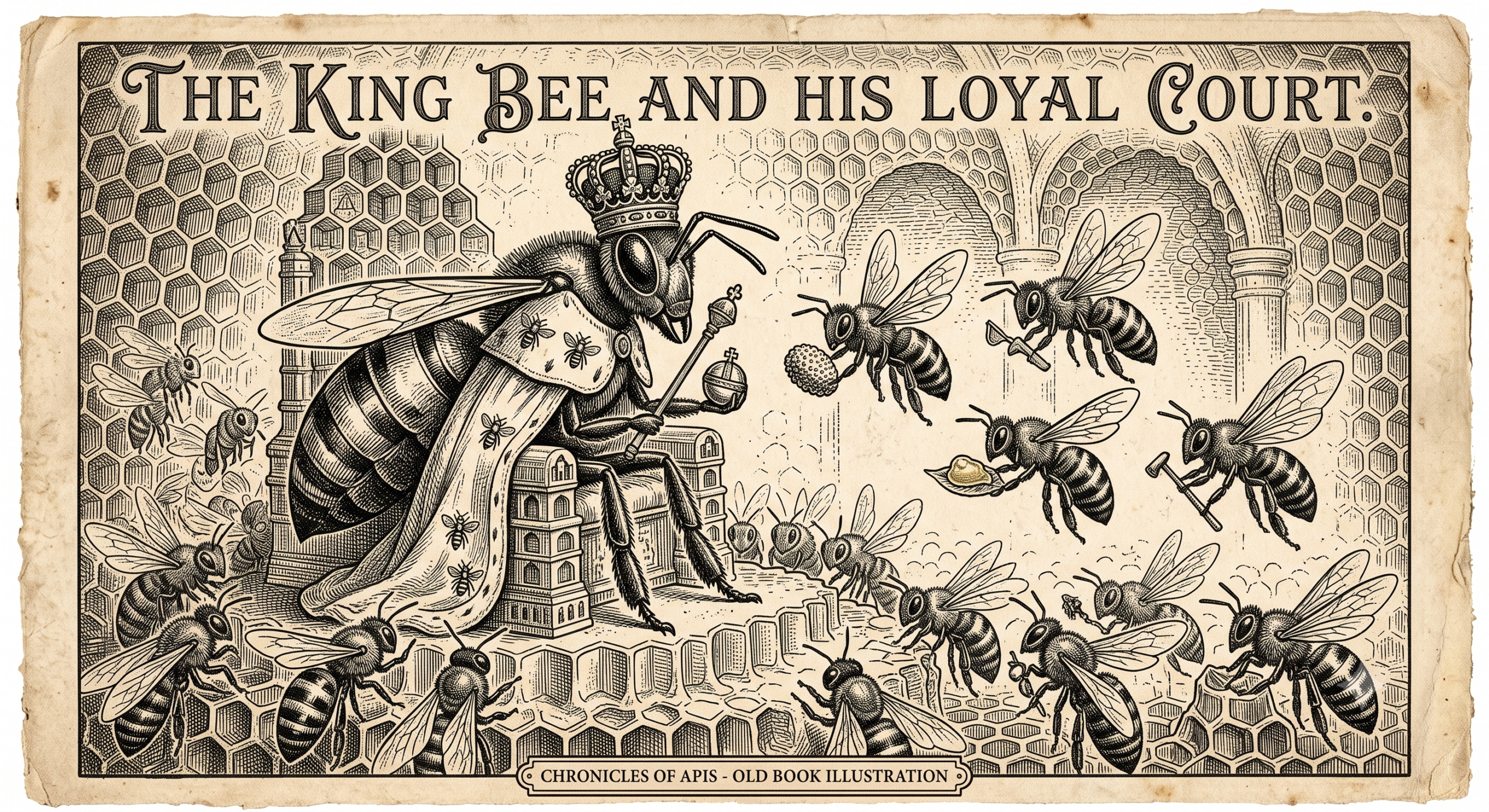
For thousands of years—dating back to Aristotle and Pliny the Elder—scholars assumed that the dominant bee ruling the hive was a “King Bee.” Because ancient and medieval societies were overwhelmingly patriarchal, intellectuals projected their own social hierarchies onto nature, assuming any authority figure in a complex system had to be male.
The shift from King to Queen is tied directly to English and European history, driven by two major turning points: political inspiration and microscopic proof.
1. The English Spark: Queen Elizabeth I and Charles Butler (1609)
The term began its major public shift in England during the early 17th century.
English apiarist and clergyman Charles Butler published a landmark book in 1609 called The Feminine Monarchie (or The History of Bees). Having lived through the long, powerful, and iconic reign of Queen Elizabeth I (who died in 1603), Butler re-evaluated hive dynamics.
He observed that the hive wasn’t a military dictatorship led by a king, but an organized society led by a female monarch. Butler argued that Aristotle had simply applied a male label by default (“with the worthier title”) and boldly renamed the ruler the Queen Bee, describing the hive as an “Amazonian or feminine kingdom.”
(Butler also famously noticed bees humming in specific pitches and wrote out a 4-part musical piece in his book called the “Bees’ Madrigal,” translating their buzzing into sheet music!)
2. The Scientific Proof: Jan Swammerdam (1637–1680)
While Butler popularized the concept politically, many traditionalists and royalists still insisted on calling it a King Bee throughout the 1600s (some, like King Charles II’s official beekeeper, Moses Rusden, continued using “King” to promote the divine right of kings).
The debate was settled definitively in the late 17th century by Dutch microscopist Jan Swammerdam.
Swammerdam performed delicate dissections on hive bees under early microscopes. He dissected the ruler bee and discovered ovaries packed with eggs, proving beyond any doubt that the “King” was not only female, but the mother of the entire hive. His work, later published in The Book of Nature, sealed the scientific reality.
By the 18th century, as microscopic science spread, the “King Bee” was officially retired from both science and popular vocabulary, cementing the Queen Bee as the rightful title worldwide.
0 Comments
Trackbacks/Pingbacks